
Academia: Brokedancing?
Thursday's Child Has Far to Go

Not that long ago, I had a strong reaction, shading into overreaction, expressed in this newsletter to several attempts at autoethnographic scholarship in my field.
Afterwards, I had to sort out what exactly what driving my response given that I felt it was ultimately intemperate and uncharitable towards the authors involved.
I would still argue that there’s a problem with the concept of ‘autoethnography’ on several levels. First, I think most good historical and anthropological scholarship has a self-reflexive element, particularly in the case of Africanist work. I don’t think you can account for how you’ve worked to produce knowledge without that element. Which means there’s something unseemly about acting like “autoethnography” is something novel, special, or set apart from other kinds of work. Second, it’s because in some cases, self-identified autoethnographers are often doing something after the fact of research to swap out the subject of their investigation. If you’re going to investigate yourself in some sense, you should start with that as the intent—Sherry Ortner knew she was investigating her own life when she was working on New Jersey Dreaming, as did Richard White in Remembering Ahanagran. I agree that sometimes a scholar sets out to study something outside themselves and finds out that the road curves back on them, entangling self and subject—as in Katherine Verdery’s My Life as a Spy, for example. But it often feels like what is encompassed formally as autoethnography is in some sense substituting a small work in a minor key for the full opus, that the footnotes are invading the main text of knowledge work.
I also still think that the particular autoethnographic works that I was responding to in that particular controversy were not very alert to the intellectual politics of the field. I don’t have any patience with the proposition that scholars shouldn’t have to think about the politics that is associated with their field, and should just publish whatever they like. I’ve never heard anybody argue for that kind of wide-open vision who didn’t immediately turn around and pass judgment on some other work as being unwise, improvident, unbalanced, unfair, dangerous, and so on. Most of the time, people arguing that every scholar should just publish whatever they like are engaged in special pleading for a particular publication. If you really seriously believed that scholarship should always be completely free from embedded preferences, norms and beliefs about the obligations or commitments of the field to the wider world, you ought be very much opposed to peer review as a practice, and eschew all the numerous instances where we are called upon to judge the relative probity or legitimacy of one scholarly project over another.
But on the other hand, I believe in experimental or unorthodox work, I trust in the judgment of other faculty about their own scholarship, I want to get as close to a thousand flowers blooming in every specialization as possible. I think being an enforcer is a bad way to be.
All of this is on my mind because I’m trying to decide how I ought to feel about the much-discussed, much-criticized, much-mocked performance of Rachel Gunn, aka Raygun, in the Olympics breakdancing competition. I don’t have direct scholarly expertise in the history of breakdancing, but I do know something of its origins and its spread. The debate about whether it is an art form (or in this case, a hybrid art-athletic competition) that is and should be completely global mirrors some similar conversations about rap and hip-hop—about how or when artistic and material practices rooted in the experiences of a particular minority or marginalized community in one part of the world can and should be adapted elsewhere, to be part of global community.
Gunn, on the other hand, is a scholarly expert on breakdancing. Which is where my feeling of uneasiness starts off. I do think it’s fair to expect scholars who come from outside of an originating subculture to at least be thoughtful about how and when they claim some form of insider status, about how they express their relationship to the community and art form they study. That goes double for a scholar who is doing so through ethnography as a method—who is studying something by simultaneously doing it and observing it.
How do performers of any kind learn to do what they do? Teaching, emulation, apprenticeship. An aspirant performer learns from master practitioners, they take lessons, they practice, and depending on the staging of the performance, may be part of public work almost right away or only after a long apprenticeship. An ethnographer working with performance might follow the same pathway into the practice, but there’s a distancing that ought to happen at the end, a kind of return out of the subculture into some form of external perspective on it. I think that calls for a tremendous amount of deliberate and continuous attention and calibration.
I don’t think it’s wise to cross the streams, as it were, to try to move into the center space of performance in the art form that you also are studying. Yes, there are always exceptions. Sometimes a person starts as a scholar and exits into performance as their central professional identity and goal. Sometimes it’s the other way round: a person whose life has been defined by performance moves into formal study of their subculture and artistic practice. Sometimes a person studies one form while being a performer in another that they don’t study. There are no rigid rules, but there ought to be some self-awareness always.
Gunn’s scholarship and teaching practice demonstrates that she’s aware of these boundaries and tries to be thoughtful about them. I would guess that with hindsight she now wishes she’d stayed clear of the Olympics competition.
However, as I read more deeply, I also found myself thinking that my own first reactions weren’t sophisticated or open-minded enough. In particular, I wanted to rethink a bit after reading a Facebook post by Dujon Cullingford, the co-lead for the Aotearoa New Zealand breakdancing team. (It’s a public post, so I think even people without Facebook accounts can read it.) The long and short of it is that Cullingford strongly refutes accusations that Gunn somehow claimed a spot on the team in an illicit fashion. He points out that accidents of timing (injuries, maternity leaves) meant that some of the potentially more competitive breakdancers were not able to join the team. He notes that Australia and New Zealand don’t have strong local breakdancing scenes compared to much of the rest of the world. And he says that the creative bits that Gunn is being mocked for are very much what breakdancing is all about, that she in no way was taking breakdancing itself unseriously or mocking it. He’s brutally honest that the problem with Gunn’s performance is simply that Gunn didn’t have the skills:
“She simply did not have the speed or finesse required to execute her movements at a high skill level so the sharp lines, swift combos and contrasting movements required to deliver an impact performance looked considerably more sluggish than the other competitors. The gesturing and characterisation which is a normal part of Breaking was marred by the lack of execution, and isolated for meme content.”
Cullingford convinces me that a lot of this is a typical social media pile-on, that folks are not pausing to think more deeply about how people involved in the subculture think about all of this.
Be that as it may, I am still left thinking that someone who is in the position of wanting to claim scholarly authority about a performance subculture needs to be especially wary of being in a performing situation where all the eyes are going to be on the scholar-performer, and doubly so in a context where there’s a complex ground shaping authenticity and belonging within the subculture. I think we all would have felt different about Eddie the Eagle if Eddie the Eagle had been a sports historian with an academic appointment who studied the history of Olympics skiing competitions in particular.
A good example of self-conscious awareness might be Paul Stoller’s book In Sorcery’s Shadow, where he very carefully tries to set ground rules around the exercise of being a white outsider training as an apprentice sorcerer in Niger. I understand that some scholars might argue that there are basic issues with the idea, but Stoller is very aware of those objections and does not simply ignore or repudiate them. I’m pretty clear that if he had found himself in a situation a few years later where someone asked him to step in as a functioning Songhai sorcerer, he would have categorically refused. (Not the least because at a key moment, he ended his apprenticeship decisively.) Cullingford asks of Gunn’s critics whether they would question the presence of many other privileged breakdancers who were on other teams, and I guess the answer is partly, “No, because they were really good at it, and so nobody noticed.” Vanilla Ice and Eminem drew very different reactions in American popular culture for much the same reason.
The worst situation for anyone engaged in a complex intercultural straddle (that also entangles different underlying motives for that straddling) is to be simultaneously highly visible and to not be able to hold up under that scrutiny. I’d like to suggest that professional ethics in academia provide some reliable guardrails to keep that moment of exposure from happening, but the more important lesson here might be that whether professional norms are involved or not, the world is not kindly predisposed to anyone whose visibility is also vulnerability—and the world is full of technologies that make people intensely visible where once they might have passed without notice.
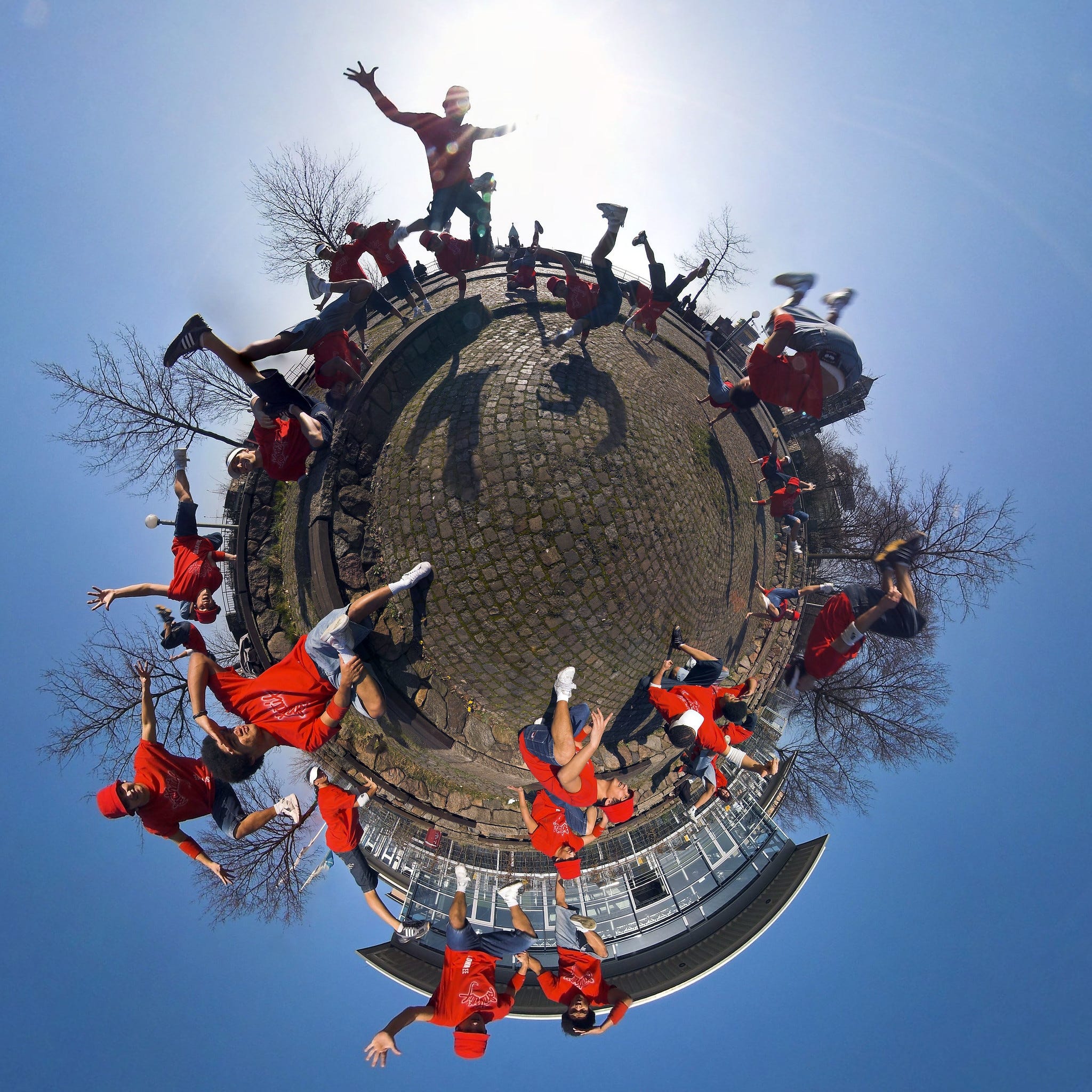
Image credit: "Breakdance planet" by HamburgerJung is licensed under CC BY-NC-SA 2.0.
Ok, first, I did not pay much attention to this at all, but now you are going to make me do it, aren’t you, Tim? Sigh. An ethnographer really, really ought to be thinking twice before entering competitions of any sort as she tries to do participant-observation. She certainly ought to refuse to enter a competition at the Olympic level when she knows that her basic skill set is…lacking. I mean, I get it: What an exciting opportunity for an ethnographer, to go to the Olympics and be on hand there for the Olympic Village, meeting athletes, seeing parts of the Games, etc. Go as part of the training team or whatever, if you can, but don’t go as an athlete when you aren’t one. To an ethnographer, this is common sense. I was capable of acting as a docent for ghost tourism in a couple of places when I was doing ethnography with the paranormal researchers there. They trained me. I had skills at public speaking. I made it clear that I was a docent, not a proper researcher or a psychic medium. (I annoyed some tourists by not pretending to be both, in fact.) It wasn’t the Olympics. It was a Friday night now and again at a supposedly haunted location. I didn’t try to muscle in on the professional, scripted ghost tours. Those are paid positions, and people have contracts to do them. Sigh. I don’t know what this scholar writes about (breakdancing in the Antipodes, I guess), but she should have stayed out of the limelight IMHO. Now, as for “autoethnography,” maybe don’t get me started, Tim.
I recall meeting a scholar whose work was “autofictocriticism”. I’d never heard of this concept. But it was auto ethnography of her own response to fictional works. She apparently got a sympathetic ear infection when she read about someone’s illness. I admit hearing about this has since colored my response to this kind of scholarship.
As for Raygun, whatever she thought she was doing, I can’t see it helping either the profile of breakdancing or her branch of cultural studies. If she wanted to get the kind of profile that will get her invited on Celebrity Big Brother though, she has succeeded.