
Do the Right Thing
We Are the Only People Who Can Save Ourselves

For a long time, I viewed the sociopolitical vision that was often called “communitarianism” in the 1990s with great suspicion. I still do, in that it often operated as a calculated disguise for conservatism of some kind or another that naturalized or protected the content of what was being described as properly communitarian from any sort of scrutiny or skepticism. It stank back then of “Third Way” calculations by people like Bill Clinton and Tony Blair and their pet sociologists like Anthony Giddens about how to keep some kind of “white working class” in their electoral corner without dog-whistling too explicitly at either class or race, via defining them as the salt of the earth who still lived in the world of gemeinschaft. As such, this sense of communitarianism bears more than a little responsibility for Trumpism. Whatever the communitarians were trying to grow, it escaped their petri dish and grew as a wild strain in other directions.
I mention it now, however, because however flawed that version of the project might have been, it’s plain that it got one essential thing right. The version of liberalism that simultaneously exalted individual liberty and the protective power of liberal institutions and the rule of law, the version that Francis Fukuyama saw as the final necessary configuration of human politcial life from the 1990s forward into the indefinite future, has failed in some essential ways. The argument between republicanism and liberalism that began in 18th Century Western Europe is over, and republicanism in some approximating sense has won. Institutional designs and legal systems intended to provide a permanent foundation for liberty cannot be made proof against corruption and vice. In the absence of the conscious agency and will of human beings to maintain and extend civic virtue, any system is an inert tool. The goggles, they do nothing.
In the context of American history, that would seem plain enough from the outset. Joseph Ellis can contort himself however he likes, but many of the founding generation that wrote the Declaration and the Constitution were plainly fully aware that they were in breach of what they’d written before the ink even dried, both in terms of land seizure and slavery. But an American who wanted to believe that the nation was being made steadily more responsible to the universal mission encoded within the laws and the institutions could, up to 2014 or so, take comfort in the appearance of that story being true: Lincoln reconsecrated the Constitution at the end of the Civil War, civil service reforms and women’s suffrage and progressive laws took further steps forward, the New Deal and the civil rights movement went beyond that. You could actually say in the early 2000s that at last the United States was living up to and in its Constitution, that its institutions were actually those of a universal liberal democracy, and that any breaches in its dedication could be solved by further improvements to the laws and the institutions.
Trump in 2016 blew a hole in that confidence. The political mainstream kept on expecting the norms and institutions to reassert themselves, and to some extent they still are in Trump 2.0, in the sense that they breathlessly track every court ruling that says the plain truth—that Trump is ignoring the laws, the institutions and the norms—with the naive trust that this alone will somehow kick the whole system back onto the tracks. Even I thought in 2016 that the institutions might just make Trump a palace captive who was allowed to mad-king it up as much as he liked on social media but was kept safely away from decision-making. Trump’s Cabinet in his first term mostly tried to do that. They failed. Trump learned his lesson, and this time he brought a fully-staffed Legion of Doom with him to Washington. The institutions, the Constitution, the laws? They’re dead letters now. Rusting away, unused.
I guess I had a premonition of this outcome when I first started trying to think about why the liberal content of anti-colonialism was never applied to the postcolonial state in sub-Saharan Africa, either by nationalist rulers or by global intellectuals and activists who identified with anti-colonialism. Nobody seemed to expect the postcolonial state to really keep to the promises of anti-colonial rhetoric about liberty, justice, or equity, despite the seeming institutional infrastructures that pointed in that direction. The people those systems needed weren’t there. I got a visceral sense of that in Zimbabwe in the 1990s. There were a few people in the ruling party who took their ideology seriously enough to be embarrassed when the party started skimming off the economy and killing people in the southern part of the country and then they were gone. Once the people in power have no sense of shame, no laws or institutions are worth anything, whether it’s Johannesburg or Beijing or Washington DC we’re talking about.
If that’s so, however, I find myself at a complete loss. Maybe one reason we clung so long to the fantasy that you could institutionalize your way to a better world, that you could write laws and procedures and policies that automatically would do the work that fallible human beings couldn’t be trusted to do, is that we understood how to do that kind of political labor. You could write philosophies that could be instantiated in laws and systems. You could approach the work like a carpenter or an electrician: work from a blueprint, work according to a technical standard. You could do experiments on non-consenting subjects—that’s what development agencies did in the Global South for the last seventy-five years, after all, but it’s also what a fair amount of social policy in the metropoles of the G-20 amounted to as well.
But how do you make civic virtue? For one, that takes having some degree of consensus about what is virtuous, which is precisely what most publics in most liberal democracies presently seem utterly incapable of reaching. For another, I deeply believe in the truth of a point I’ve made for most of my adult life, which is that you can’t indoctrinate your way to virtue, not through churches, not through schools, and not through popular culture. Back when American conservatives actually believed in virtue, that was the conservative answer to this problem as well as the accusation they often made: that you had to codify virtue as a set of ideological dictates and then you had to compel all citizens to learn those virtues and cohere to them. The conservative argument was that this is how it worked in the good old days and how we could get back to it. I don’t think that’s empirically true and I’m pretty sure that as a moral proposition it lacks civic virtue.
This is precisely what so-called “neorepublicanism”, a mutant offspring of communitarianism, gets wrong: they think of civic virtue as something they control and make not through dogmatic enforcement or indoctrination but through actions like “nudging”. That’s obscenely off not just because it doesn’t work but because it always makes the nudger into someone who assumes their own virtue is an immaculate and complete model for what they wish to produce in other people. There is a narcissism to their vision that is less exaggeratedly common to most conversations about civic virtue. The people who worry about it most are invariably priggish and self-satisfied. I think you learn more about the right way to live and be together in community from the cynics, the doubters, the skeptics, the people who are more prone to self-reflection.
It seems to me that when communities possess civic virtue, when they have a moral fabric that encodes a respect for rights and justice deep into everyday life, that comes from so many sources that it can’t be produced on purpose, from above, as an instrumental project. That kind of virtue comes from life experience, from seeing life done badly and done well in families, in neighborhoods, in workplaces. It comes from really basic ideas: do unto others, forgive us our trespasses as we forgive those who trespass against us, walk a mile in another man’s shoes. It comes from movies and fiction, from history. It comes from witnessing but also abstract reflection. From joy and tragedy. From transgression and transcendance, from grace and anger.
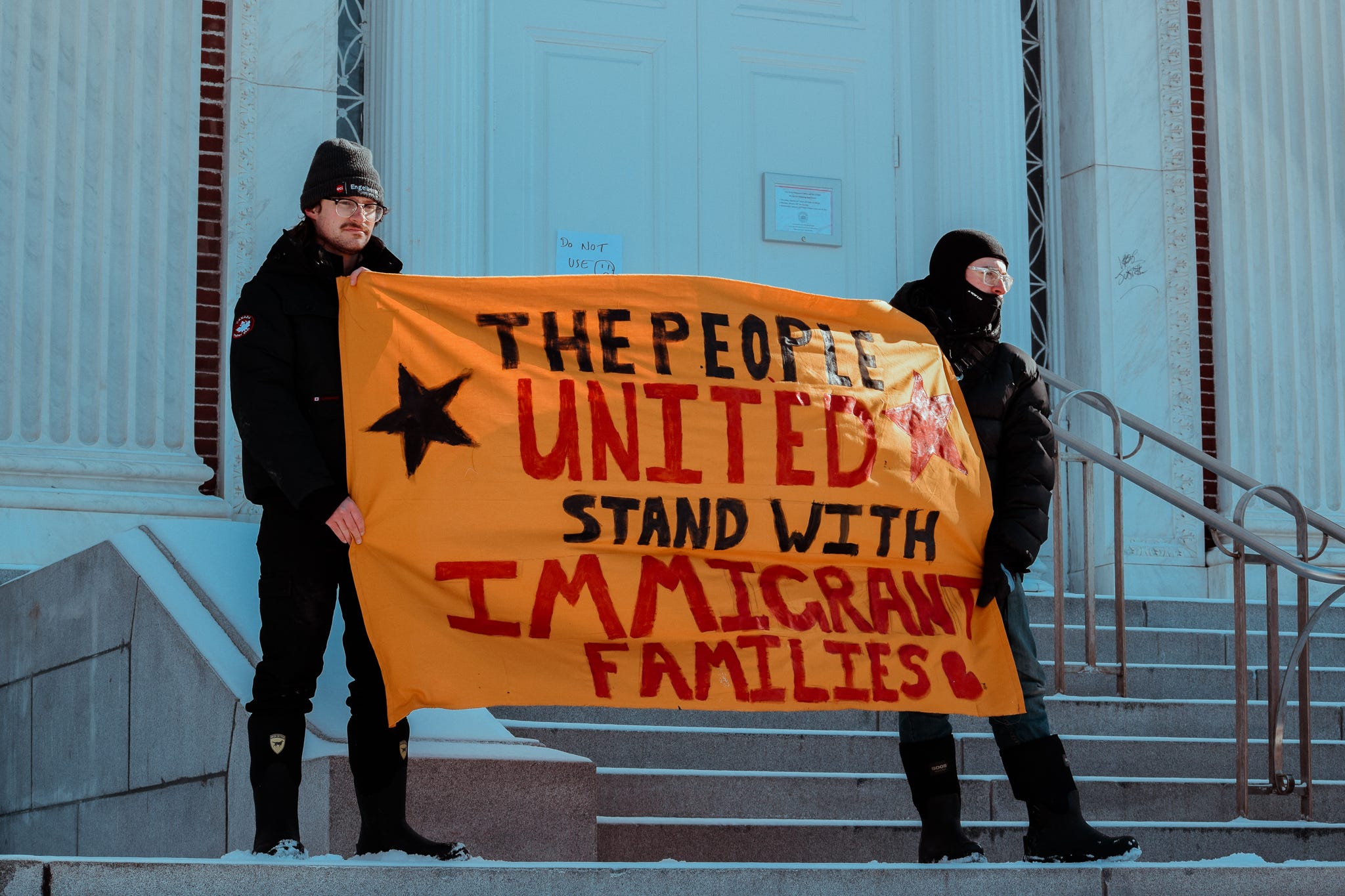
And so here, perhaps, we are not in breach in our promises of freedom and justice. Because where and how is Trumpism being most effectively stymied in the United States? Not by the institutions, and not by the courts, but by everyday decency and courage. By people who intuit how we ought to live and by people who are feeling a yearning to live better. By people who are maybe letting regret trickle into their hearts as they see their worlds unravelling in ways they didn’t anticipate. Maybe we’re all understanding that we’ve been having stupid arguments for way too long about the precise formal and legalistic words to use to describe or depict the diversity of our actually-existing social worlds, that we’ve been subcontracting the labor of everyday decency to people running workshops and doing trainings. We’re living into what we want, we’re wanting what we live, even as our lives are increasingly threatened.
That there is more work to do in that sense is plain enough. We need to talk with one another about the emotional and philosophical underpinnings of the policies and laws that we want restored or protected in recognition that those have become unfamiliar conversations. That talk needs to be unadorned by expertise or dogmatism. We need to rewrite the relationship between the virtues we feel in the bone, the knowledges we often cite with excessive confidence, and the institutions we maintain or want restored. The institutions rise from us and express out of us, they aren’t and never have been machines that enforce freedom or justice.
But what do we do when we know that virtue has badly atrophied, as it has from our oligarchic billionaires, from most of our political elites, from many journalists and experts? What do we do when we know that out there there are other kinds of civic ethics that point at a very different world, that accept that life is a violent struggle for supremacy, sensibilities that also arise from experience and feelings and simple propositional ideas about the world?
I wish I knew. One step at a time, I guess. The first step is to abandon, once and for all, the idea that our institutions and laws can do the work that people can’t be trusted to do. That the things and systems we make can save us from ourselves. That’s exactly the wrong way around.
Image credit: By ellerieann11 - https://www.flickr.com/photos/202224542@N08/54283741243/, CC BY-SA 2.0, https://commons.wikimedia.org/w/index.php?curid=159018858
What an important and insightful commentary, Tim. So many questions that we thought were "settled enough" that we could ignore them turn out to have not really been settled at all—just suspended for the time being. Now we have to take those questions up again. And we are out of practice.
This is really important Tim, and some beautiful expression within. My mind went to those somewhat occasional things we as some kind of collective entity have to do. And which we tend to do so poorly. We early exchanged about the hard difficulties of finding or choosing university leaders. But another comes to mind, with this post of yours being the pus hereh. How would such values, ways of thinking and working, enter the actual speech and questioning of candidates for the U.S. Supreme Court who have practiced responses to predictable questions producing a lot of speech with little understanding of how to work with "the only people who can save ourselves," the We? I'm thinking of the challenge you raise about civic virtue, that it "can't be produced on purpose." (I really love, embrace, that paragraph, Tim!)