
Fixed Narratives, The Next Round
Come On, NYT

Why look, an oral history of the 1968 Democratic convention in Chicago!
It must be a major anniversary or something? Wait, no, that would be 2028. Well, it’s the first time since 1968! No, that was 1996. It must be uncommon to meet in Chicago? No, the Democrats have convened there 12 times in the history of presidential elections. Students are protesting, that’s it! There haven’t been students protesting anything since 1968, and certainly never at a major party convention.
Look, I’m a historian: I always welcome more oral histories. Unless, well, they don’t add anything at all to what we already know and they’re being collected by profoundly incurious interlocutors.
You expect with each passing year that people remembering their participation in past events will discover new meanings as they tell the story. Some moments that seemed of great significance once upon a time may seem diminished. Things that seemed completely unprecedented have come to seem banal, or things that seemed typical for the times now seem extraordinary. People who would once have defended every action they took now shake their heads and wonder what on earth they were thinking. People who were mystified at events now understand far better what was going on behind the scenes. People regret where they had pride, and feel pride where they were apologetic. Or people dig in: the story hasn’t changed from that long-ago moment until this very second.
To get any of that, if you’re going to bother doing “oral history”, even journalistically, you need the whole transcript. You need a long conversation. You need as many people as you can find, particularly some unexpected witnesses and participants. In the case of many celebrated or notorious events, one of the most powerful things to do is find people who weren’t centrally involved but who were present, people who happened to be there but not as leaders or decision-makers. Go to scenes that aren’t part of the conventionally known story. Go talk to whomever got sent to reservoirs to guard against the supposed threat of LSD being put in the water. Find the person who was in charge of minding Pigasus. See if you can find a person who actually did throw a bag of feces at the cops and ask how they collected the poop. Find a delegate who stayed up in their hotel room to talk with friends. Find someone who was in the secretarial pool at City Hall. If Daley was mostly scared of riots “in the neighborhoods”, then go talk to people who were organizers “in the neighborhoods” to find out why or how they kept the lid on. But whatever you do, don’t just give a few snippets and move on.
The NYT piece is a set of fairly banal, familiar and short reflections about events that have been recounted a great many times. It’s fine, I guess—but it’s all rather transparently in service to analogy-making, which the article starts off laying out and then acknowledges that the analogies are weak.
I grant that the BBC and every other major news outlet has an analogy-seeking piece up today as well, which shows in part how strong the herd mentality in journalism often can be. In a sense, the whole thing feels like yet more tedious Boomer self-reflexivity of the kind that came roaring out during Bernie Sanders’ presidential campaign as well: “Kids! Don’t be like us! Don’t get Nixon elected!”
The image for me is more like a scene from an episode of The Prisoner where Patrick McGoohan’s Number Six is being conditioned via an electric prod to favor the wrong hand as part of a psychological plot to confuse him about his own identity.
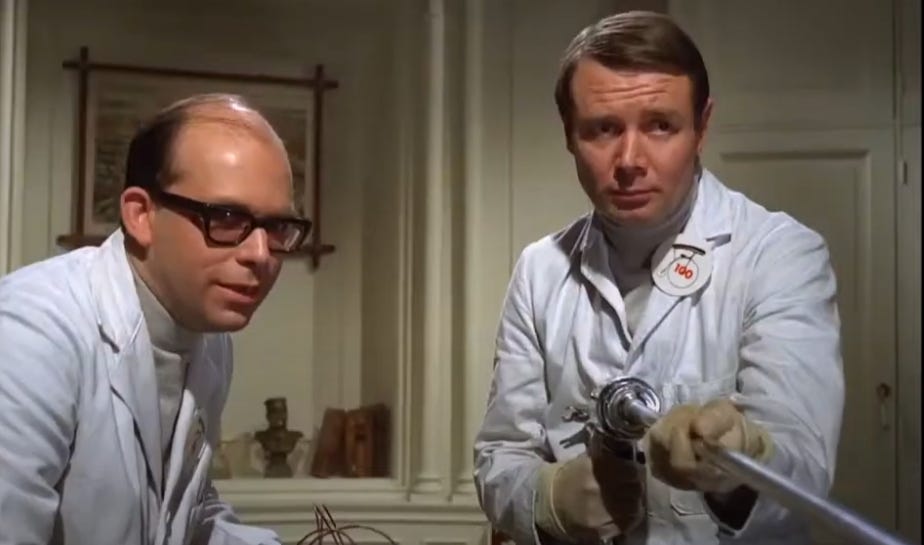
That’s pretty much the whole of the convention coverage at the Grey Lady this morning. If it’s not “watch out for protesters!” and “shut up about Gaza, you kids”, it’s “Harris doesn’t have hundreds of pages of detailed policy proposals, what kind of campaign is this?” At least Maureen Dowd comes honestly by her senescent befuddlement about a coup being a coup or whatever.
Do they want to elect Herr Drumpf, or is all this in aid of some obscure journalistic consideration that I can’t quite figure out? This morning I blocked the Times from my email feed, not just from my apps. I literally cannot read this nonsense anymore.
The NYT's behavior is genuinely puzzling at this point, even if they do want Trump back. My pet theory is that they (for some values of "they") believe they are the Conscience of America and that they will hold account anyone who will accept being held to account.