
The Re-Read: Todd Gitlin, The Sixties
Sunday's Child Is Bonny and Blithe

On hearing of Todd Gitlin’s death, I felt a desire to re-read his chronicle The Sixties, originally published in 1987.
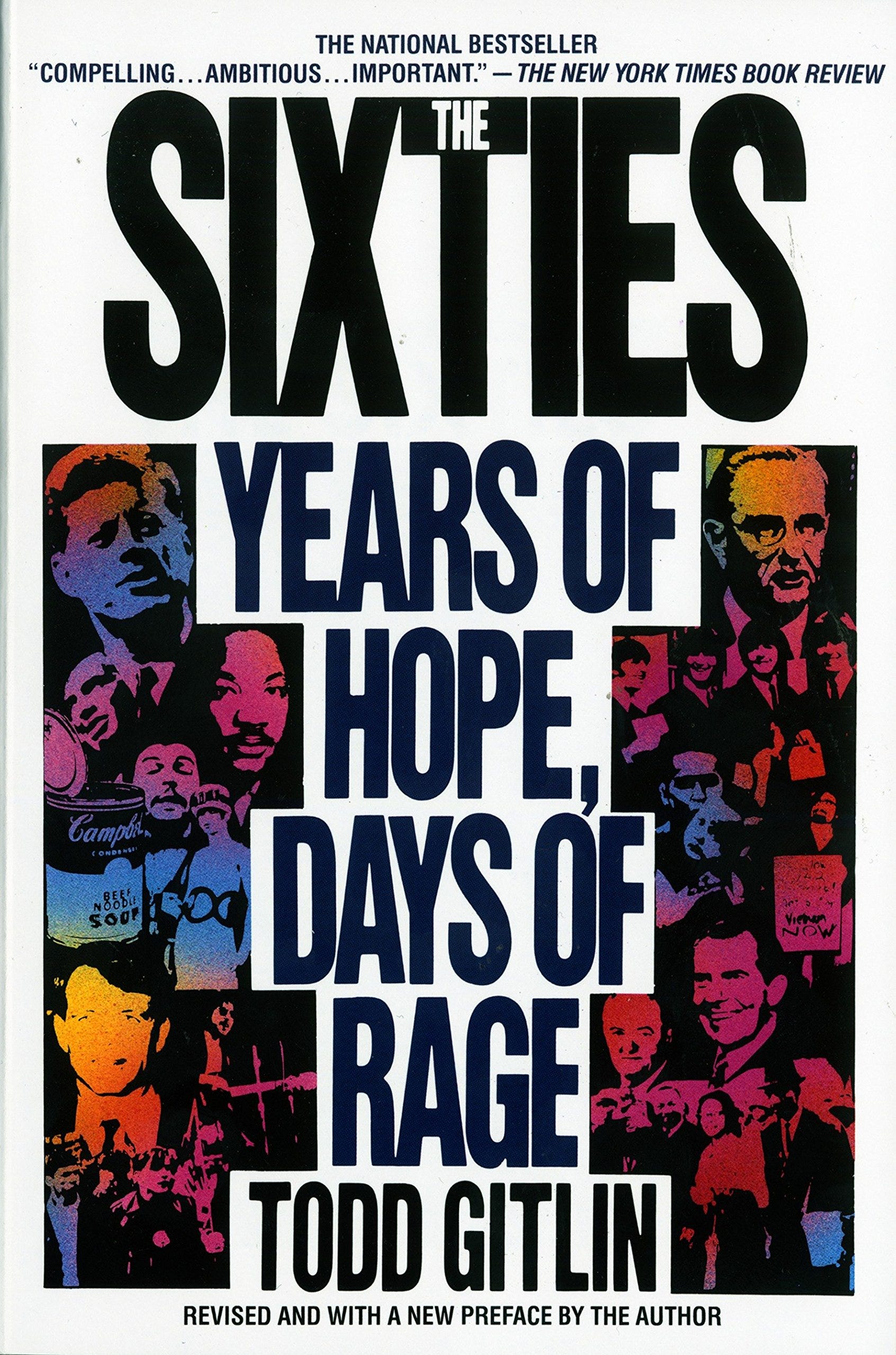
It’s sort of connected to the first job where I was in the role of a teacher. I taught in three “enrichment” summer school sessions at Choate Rosemary Hall before I went to graduate school, and the first time I was paired with a “master teacher” in a course on the history of the Sixties. We used a collection of primary texts as the main text. Gitlin’s book hadn’t come out that first time I taught it but it was out the next time I was back teaching the summer session.
I know there are many of Gitlin’s contemporaries thinking about their own traversal of that same historical moment after the news of his death and that many looked to him as an explanatory or representative figure—of what went right, what almost could have been, or of how it all folded back into complacency. Gitlin’s memoir/analysis characteristically does a great job at copping to all of those understandings and working the frame between insider and observer again and again throughout the book. As he notes in the opening, he’s trying to think through whether or not he and his contemporaries made mistakes that they could have avoided and whether they deserve any credit for what they are commonly held to have accomplished. The book remains both charming and disarming, at least to me—you can feel the intensity of his sincerity, of his pull to unrestrainedly honest introspection but also his responsibility to put things in perspective.
I went to college in the Eighties, which Gitlin comments “rewrote the Sixties”. I identify as GenX, though I’m in a contested zone of birthdates that some people either see as the last year of the Baby Boom or the first year of GenX. I know I had a very fraught relationship with the Sixties in my own experience of activism, study and thinking. Enough to absolutely recognize the push-and-pull between something like a countercultural desire and something like the politically focused New Left that Gitlin was associated with as a tension we were still wrestling with, but also to see what had changed since then. On more than one occasion, I frankly hated the Sixties because it seemed to me it had created a strong mythologized template for social action and cultural change that we were constantly pulled towards even when it made no sense in terms of our own struggles, interests or needs. (Told you that I identify as GenX: that’s our core generational identity, which is annoyance at having to constantly breath in the fumes of the generation traversing history ahead of us.)
By the time I was reading Gitlin’s book and teaching this history to high school students who were eight or so years younger than me, I was deeply familiar with the names and events associated with that time (including Gitlin himself). What Gitlin did for me then and still does now is to complicate and make intricate the procession of icons and defining events in a useful way that gives me perspective not just on his Sixties but the Sixties we had to struggle to get free of and try to live up to.
I don’t think the people who came after us had the same struggle. I could see that even with the students, very nearly my contemporaries, that I taught in that class. There was one spectacular outlier whom I’ve never forgotten who was especially free of any knowledge of the Sixties—I managed to absolutely blow his mind in the course of one lecture about the formal political history of US elections and institutions during the decade by informing him of something he had miraculously never heard before, which is that a sitting president, and the president’s brother who was running for president, were both assassinated within five years of one another, along with two major civil rights leaders. But even the students who were more dialed in approached this all as history rather than a weighty mythology that they had to reckon with in order to claim their own place.
Rereading Gitlin now, that kind of need for psychic and generational independence has faded completely for me. What is on my mind now is less a sense of trailing behind a familiar history and more lessons to be learned from what now seems quite strange or unfamiliar about it all. To have a sense of moral urgency, a call to action, arise from discomfort over those excluded from affluence and security, is so obviously not like the present moment, with its instability, its insecurity, its sense of downward mobility and loss.
The book also does a great job of re-narrating the Sixties to make clear that events and trends that were being furiously rewritten as converging and simultaneous in the lives of everyone living through the Sixties were experienced as separate or simply not noticed at all by many. Hearing the music—which music? nobody heard all the music—wasn’t always thought of in the same frame as Rosa Parks or the Port Huron Statement. People travelled through a decade and a generation living different lives and paying attention to different things; the urgent mythologizers combined it all together into a single compressed zeitgeist for instrumental effect, to try and draw people into their political and cultural projects. I really love the structure of this book for both picking separate things apart and yet also recounting the process of how they came to be associated with each other in the historical narrative and in the memory of the Boomers themselves.
I wonder some at how it would read to a twenty-something now. I kept thinking as I read about which names recounted in passing or referenced as if they are familiar have stayed familiar and which have not, of what names and moments get explained as if the reader has never heard of them (or not so much) and which they are presumed to know.
There’s a sharpness to the description at times that reminds me of another favorite book of mine, Garry Wills’ Nixon Agonistes, and then sometimes that sharpness fades into a more professorial, third-person descriptive voice—a tonal alternation that Gitlin was clearly aware of (he says as much in the introduction) but it sometimes created a sense of interruption or disjuncture as I read through it—I’d smile at how clever or wickedly observant a particular characterization was and then suddenly it would drop into an extended narrative recounting of the history or a background explanation of a particular figure. Some of this alternating actually corresponds to Gitlin’s own divided identity: an academic expert in the sociology of mass communications and popular culture; a political thinker still wanting to hold on to the possibility of organizing for social change. Much as he recounts later in the book of his feeling both a distaste or annoyance for the counterculture and being drawn towards it and into it.
It’s a sideline, but I feel like liberal and nationalist anti-Communism really needs a comprehensive historical revisitation by historians and intellectuals who aren’t just continuing to settle old scores (that’s most of what’s been written in that space). Gitlin’s recounting of James Wechsler and Jack Kerouac being up on a stage in 1958 really got me thinking about this again. The main story there is basically how a committed liberal instantly transformed on that stage into a square without understanding at that moment how that was being done to him or knowing what he could do about it—something I think is almost the continuously repeated experience of establishment Democrats ever since. But there’s also something of the moment that we sometimes miss (because some people don’t really want to dwell on it) of all the people who were urgently involved in activism in the 1950s and 1960s for whom what they understood to be “Communism” was something that they really disliked without any desire to curry favor with Cold War ideologues—I see this sometimes in tracing some African and African diasporic activists and nationalists, often in the people who eventually got pushed aside or sidelined, or sometimes the folks who hovered around the edges of movement work.
Anyway, Gitlin lived a meaningful life, and at least for me, is a fantastic examplar of one of the best ways to do that, which is with some degree of humility and self-awareness, some capacity to think critically about oneself and to put oneself into perspective. It was a good experience to reacquaint myself with this book now that its author has left us behind.
I am realizing now I've never read this book and really need to. Even though I was quite young 5 or 6) I remember vividly my family talking about RFK and MLK being killed just months apart, and RFK's brother being killed as President. I think that might have been the first time I was aware of news of the outside world (outside of my family that is) as being something important to pay attention to. Tim, I also fondly remember the first time you told the story about that student in your Choate-Rosemary Hall class. His reaction was so genuine.