
Gastrodome: E Is For Egg
Monday's Child Is Fair of Face

Did you know you can’t eat the eggs of the alligator gar fish? Or any gar fish? Just in case you were wondering.
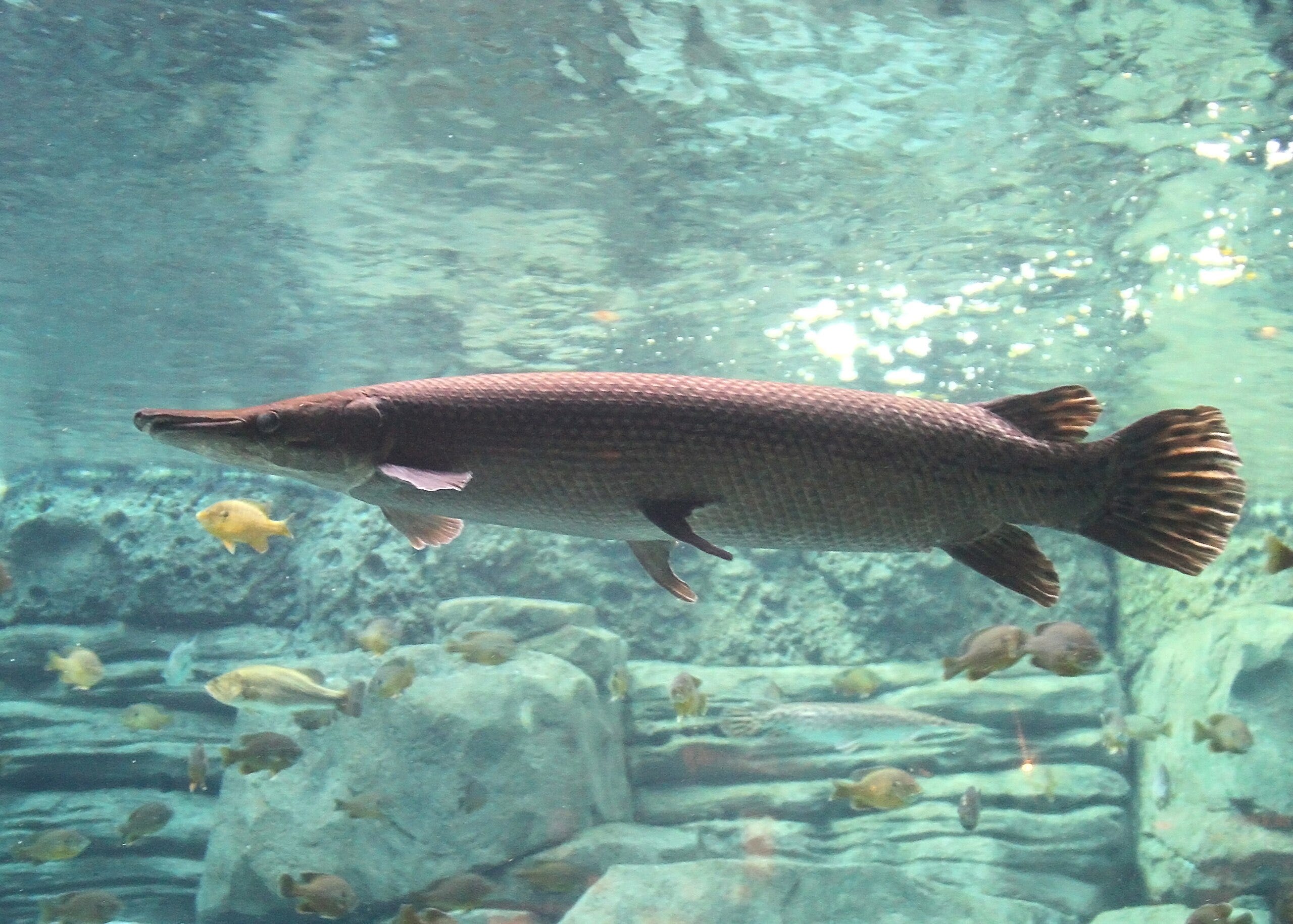
I learned this because I was trying to find out if there are any eggs of any animal that human beings don’t eat. I found one 2020 article documenting a case of poisoning from eating gar eggs, and that wasn’t good enough for me.1 I thought on reading the article about the supposed poisoning, “Well, what if that’s a misidentification? A person who got sick and blamed the eggs?” But I kept digging, and you know, there are other documented poisoning cases going back a ways. There are fishermen who’ve caught gar and managed to eat their flesh (it’s difficult because their scales are so hard) who’ve warned other gar fishers not to eat the eggs. There has been research on gar egg toxicity that puzzles about why gar eggs have a strong ichthyotoxin, a poisonous protein, that kills crayfish and makes humans very sick but doesn’t bother fish species that might actually eat gar eggs if they found them.2 I also discovered in the course of this investigation that the Director of Research for the Texas Game, Fish and Oyster Commission in the 1930s invented a device called the Electrical Gar Destroyer intended to kill all gar within a body of water because he found the mere existence of gar so hateful.3
But I digress.
Why, you might wonder, has anyone who has caught gar decided to try eating their eggs? I think it’s because gar look like this fish, a sturgeon:

Whose eggs are available for purchase, if you have the money.

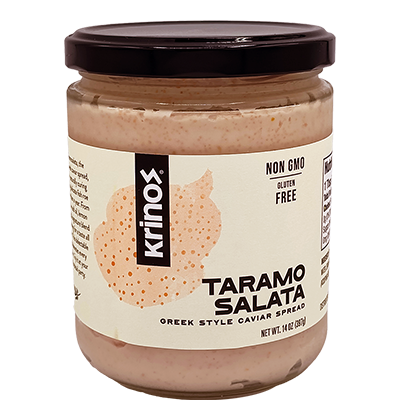
As are the eggs of many species of fish, in fact, though generally we call them “roe”. Among my personal favorites are shad roe, which is only available in the spring along the Atlantic coast of North America; tarama, which is the roe of a carp species that is typically sold as taramasalata, which is a mayo-like spread; and bottarga, which is a cured pouch of mullet or tuna roe that is usually grated on to food in Italian cuisine. (Of these taramasalata is the easiest for American consumers to buy: I find Krinos’ brand of it at Wegman’s, for example.)
Humans also eat the roe of sea urchins, usually known as uni, since it was popularized in the U.S. through Japanese cuisine. I love it and so do a lot of high-end chefs, and there’s a special bonus if you’re on the West Coast, because eating uni is practically your duty to the ecosystem. It’s like splatting a spotted lanternfly in Philadelphia, because sea urchins are killing kelp forests due to the overpopulation of both red and purple urchins.
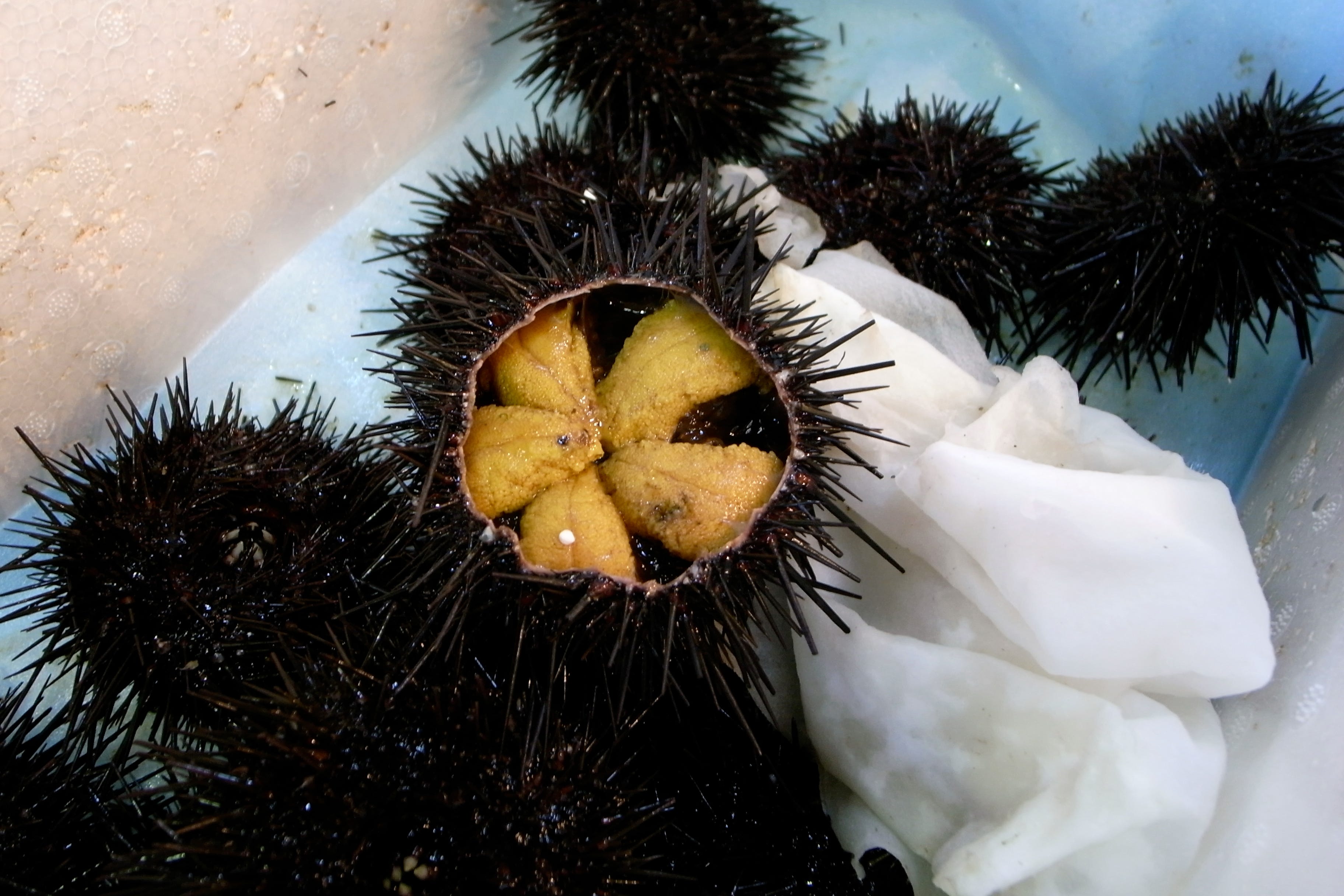
I do have some bad news for squeamish uni eaters, however. (I think that’s probably a small subset of people who eat it.) “Roe” means eggs, right? Well, no. Like a lot of food euphemisms (“sweetbreads”) it’s used as a pleasant-sounding distraction from what you’re really eating. In the case of uni, that’s the sex organs of a sea urchin.
Anyway, we’ll save gonad-eating for another letter of the alphabet. (Or not.) Uni isn’t eggs. But a lot of things that human beings eat are, which is a habit we share with most omnivores and carnivores. The only animals whose eggs humans don’t eat, aside from the eggs which are poisonous to us (and even there, as repeated rediscoveries with gar eggs show, somebody will often give it a try) are mammal eggs, and that’s because they don’t exist outside of mammal bodies.4 (I am not going to look up whether there are cuisines that prize eating mammal ovaries today, thanks.) Humans even eat a fair number of insect or invertebrate eggs like ant eggs. If they’re laid, I think it’s likely that people have tried and often succeeded in eating them.
I think it’s a fair guess to say that when you say “egg” in the context of food, most people think you’re talking chicken eggs. There are a few other bird eggs that are eaten a fair amount—duck and quail eggs are pretty easy to find in markets. Turkey eggs are excellent but I rarely if ever see them for sale. I’ve had ostrich egg but as you might guess it’s only something you’re going to find where there are active ostrich ranches, which is one of those livestocking trends that folks try to talk up now and again.
You can take or leave caviar, or anything sold as roe, but chicken eggs seem like a hard thing to do without. I think it’s the single thing that would give me the most pause about trying to eat a purely plant-based diet. At a fairly primal level, an egg seems like the most harmless way to eat animal protein—a hen lays one regularly, and unless it was fertilized by a rooster, it’s practically begging to be eaten by another animal. It feels like a fair deal, if you keep a laying chicken: I feed you and protect you from predators, you give me eggs. If you have something like a “chicken tractor” the deal gets even better—the chickens save a bit on feed costs, they eat harmful pests like cutworms, they enrich the soil, and you still get the eggs.
I understand that for people who prefer a vegan diet for ethical reasons, the miserable industrial conditions that attend on a lot of egg production are intolerable. But it’s a place where the market has been somewhat responsive and it is possible to buy more ethically-produced eggs. (Though “cage-free” may not always mean what consumers think it does.)
There was an old ad campaign by the American Egg Board that extolled “the incredible edible egg” and that for once doesn’t seem like commercial hype. Though that might make you wonder why they did the advertisements, and the answer was that there was a point where nutritionists were blaming eggs for high cholesterol levels, a finding which has been modified considerably over time.
There are so many ways just to eat a chicken egg as such, and most people have strong preferences. Fried? Do you want the yolk runny or not? Do you like the white crispy? Scrambled? Do you want them soft, a little liquid, or dry? Soft-boiled? Getting those just right is a difficult culinary art unless you cheat with a sous-vide. Hard-boiled? So many dishes come from that—devilled eggs, egg salad, and so on.
Those kind of egg preferences are really visceral. A person who doesn’t like runny or liquid eggs is often going to be profoundly nauseated if you so much as set that in front of them. A person who just has to dip some toast in a runny yolk is going to lose their cool if it’s hard-cooked through.
Hovering in the background is also that raw egg is dangerous—primarily due to salmonella risk—but it’s also the best way to make a great mayo or a number of salad dressings. Which is where chicken eggs really become important: they add a lot to sauces. They are great binders in meatballs, and crucial as a way to get a coating to stick on something that’s going to be fried. They make pasta possible, they make a lot of doughs and pastries what they are.
There are huge distinctions in baking between yolks and whites. Whites are just protein, so they can bulk up something you’re baking especially if you whip or froth them a lot. Yolks are protein but also fat, which is key to their role in emulsification, in making oil and water (or liquids with a lot of water in them) combine.
There are strategies that vegan cooks can use to adapt to the absence of eggs, but it’s a big loss in purely technical terms—eggs do a lot of work that you don’t taste too much in the final product. I had no idea as a kid that mayonnaise is basically just eggs and oil with a teeny bit of mustard and vinegar: I thought mayonnaise was just itself, and not made from anything else.
I don’t have to imagine the distantly past day where human beings first ate eggs. I am sure that goes back to the earliest hominims: we have been stealing from bird nests for our entire existence as a species. The whole point of an egg is provide concentration nutrition for an embryo during its development. That’s pretty irresistable. But I do wonder sometimes at how the culinary geniuses began to discover what an egg could do combined with other foods. Emulsification, for one, is a tool-user’s art: you can’t just put things that like to stay separate together and wait for the magic to happen. The binding properties of eggs we know were in play at least eight thousand years ago, and probably earlier.
The other question I had for myself in starting this essay is whether there are cuisines that prize eating partially grown embryos that are still in the shell. I figured that if it’s an illegal treat to eat a little songbird in France, there are going to be people who like a bit of bird protein in with the egg. Sure enough, duck eggs with partially-grown embryos are eaten as a dish commonly called balut across a fair range of Southeast Asia. I haven’t had the dish, but I don’t have any qualms about the idea of eating it—if I have the opportunity, I’ll give it a try. I wouldn’t hold my breath for the American Egg Board to start promoting the dish, but it’s legal to prepare and consume in the United States—you can get balut from Metzer Farms, who also sell duck and geese hatchlings to farmers.

But thinking about balut goes back to the point that eggs also do provoke a lot of strong gustatory reactions in many eaters, and in many cultures, for that matter. I think on some level the issue isn’t just textual and it’s not just taste. The egg is something that invites you to forget what it is, which is really the most incredible thing about it: it’s one of the most amazing strategies that animals worked out at an early evolutionary moment, though shelled eggs came along quite a bit later. (Still well before chickens, so if you are satisfied with that way of answering the old question, the egg came before the chicken.) If eggs aren’t fertilized, they really are nutrition that’s just sitting there waiting to be eaten, to the point that there are predators that specialize in egg-eating, or ovivory. Obviously any animal whose eggs get eaten so much that they never have a chance to be fertilized or to hatch is in big evolutionary trouble, which is at least part of the reason why many eggs are hidden, protected, or guarded. As with a lot of our food, we are sometimes so distant from what it is in biological terms that we forget what every egg thief knows: it’s food and home for a baby. Maybe as mammals that’s especially easy for us to forget because it’s not the way we roll. But as an enthusiastic omnivore, thinking about what an egg is doesn’t put me off, it just makes them more amazing.
Though I’ll stick to the ones I know are edible, thanks.
Image credit: By Greg Hume - Own work, CC BY-SA 3.0, https://commons.wikimedia.org/w/index.php?curid=30364231
Image credit: By Jiaqian AirplaneFan, CC BY 3.0, https://commons.wikimedia.org/w/index.php?curid=61015266
Image credit: Photo by Robert Anasch on Unsplash
Image credit: By Naotake Murayama from San Francisco, CA, USA - Fresh Sea Urchin, CC BY 2.0, https://commons.wikimedia.org/w/index.php?curid=32732786
Martin, H., & Akpunonu, P. (2020). Treating Ichthyotoxin Poisoning Induced by Gar Eggs Ingestion. International Journal of Medical Toxicology and Forensic Medicine, 10(3), 31548. https://doi.org/10.32598/ijmtfm.v10i3.31548
Ostrand, Kenneth G., et al. “Gar Ichthyootoxin: Its Effect on Natural Predators and the Toxin’s Evolutionary Function.” The Southwestern Naturalist, vol. 41, no. 4, 1996, pp. 375–77. JSTOR, http://www.jstor.org/stable/30055193. Accessed 10 Nov. 2025.
See Mark Spitzer, Season of the Gar, University of Arkansas Press 2010, p. 121 for this and many other gar-related facts and thoughts.
Yes, yes, I know, monotremes. I suppose somebody’s eaten the eggs of echnidna and platypus.