
News: Fragile Powers
Wednesday's Child Is Full of Woe

I recently attended a talk by John Mearsheimer, the well-known international relations scholar who describes himself as a major proponent of “realism”. In Mearsheimer’s view, what this means is that he believes that any given time in history in any region (or today, at a global scale), there are sovereignties which are considerably more powerful than any neighboring polity, and the relationship between these “great powers” is the major determinant of outcomes in interstate or inter-polity relations in that region. Mearsheimer believes that these great powers will always and inevitably be rivalrous, will always strive for supremacy, and that they will pursue these rivalries in more-or-less rational ways even if and when their individual leaders or political elites are not personally rational. E.g., the material underpinnings of state power and the institutional infrastructures through which they act will invariably push those states towards the maximization of their own influence and power within international relations even when leaders misperceive their circumstances.
I’ve never been fond of Mearsheimer’s work, nor of work like it, because I simply don’t think states are rational actors. In fact, I don’t think states are agentive at all in the way the word “actor” implies. States are assemblies of governmental and non-governmental institutions; of citizens, residents and migrants; of territories, topographies and materialities; of hierarchies and relationships. They shamble and strumble towards particular ends and possibilities, through long-standing narratives and imaginaries; through the cajoling of leaders and the embedded powers of bureaucracies. Realism as Mearsheimer describes it is one of many post-facto stories that people with power (and sometimes people out of power) use to explain why things happened the way they did, to create a tighter coherency than actual processes of change and activity had at the time. It’s a popular language among high government officials in part because it flatters them, grants them supra-rational capacities, makes them seem like the high priesthood of a divine being.
Still, the talk was an engaging performance, and as Mearsheimer talked he gestured towards nuances that his published work also contains, as he acknowledged that ideology and culture do matter, that realism is just a model and reality is more complicated, and so on. (He also indulged in his famously controversial critique of the Israel-U.S. relationship and of U.S. support for Ukraine.)
I was struck, however, by Mearsheimer’s repeated distinction between his version of “realism” and what he generally referred to as “liberal hegemony”. In his description, “liberal hegemony” was what the United States did after the end of the Cold War, where as the sole “great power” it attempted to wholly incorporate the entire world-system and all countries within it into liberalism, to bind all nations to international institutions that were shaped by neoliberal norms. For some reason, he saw that as distinctive from the way that the United States evangelized for liberal democracy during the Cold War, perhaps because it accepted that its “great power” rivals (the USSR and China) would not accept liberal democracy and perhaps because as a great power the Cold War American government readily accepted and relied upon client states that were profoundly illiberal—Marcos, Mobutu, Banda, the Shah of Iran, Somoza, Duvalier, and so on.
I found myself thinking what I know some other critics of “realism” think, which is that what Mearsheimer calls “liberal hegemony” is arguably just another form of realism, that it was mostly just a strategy by which a great power tried to retain its dominance over its rivals. The argument here would be that it’s better to have everybody inside a system, invested in its workings, to create interdependencies so fierce and profound that nobody can afford to challenge the global hegemon without hurting themselves.
In his talk, Mearsheimer discussed Putin’s Russia, primarily by way of suggesting that if NATO and the EU, with American backing, had not expanded eastward, Russia would have been content to remain a regional power and accepted American primacy otherwise, but that the challenge to Russian interests within its own regional sphere forced Putin to move towards reviving his nation’s “great power” status. Here his “realism” suggests to him that a great power is wiser not to give a regional power what it needs and react only to any attempt to enlarge its sphere of influence. This argument flipped whenever he turned to China, which was frequently, where he claimed that by incorporating China into global liberalism, the United States empowered China and made it a “great power” in the post-Cold War world, where instead the U.S. should have persistently worked to cripple China and keep it no more than a regional influence.
Here I turn back to my basic objections to the whole framework of analysis. I just don’t think “the United States” and “China” are coherent actors in the way this approach sees them. Moreover, even if they were, Mearsheimer’s understanding completely refuses to see China as an active force in its own status, as if it was entirely on the United States to decide to allow or forbid China to become what it has become in global terms. It’s also hard to see in Mearsheimer’s counterfactual what he thinks proper realists in the U.S. government ought to have done to China between the late 1980s and 2016. Limited their trade? Banned American corporations from operating there? Frozen the Chinese government out of international meetings and associations? Practiced some form of containment with regional proxies? I have no idea why he thinks that those kinds of actions would have been more durable at protecting American supremacy than “liberal hegemony”.
In fact, I think we are seeing right now just how successful “liberal hegemony” was at institutionalizing American advantage in the post-1945 and post-1990 world order. That advantage was expensive to maintain, in that it required maintaining a large and technologically sophisticated military, an expansive program of “soft power” engagements especially through development and economic aid, and responsive attention to and responsibility for global-scale problems as well as local disasters and emergencies. From the perspective of someone who saw those commitments just in terms of maintaining dominance and the advantages that come with it, it was also expensive in the sense that it forced the United States into a series of cyclical contradictions—that to expand liberal hegemony also meant some degree of serious obligation to the promises and potentialities of liberalism, which in turn checked the ability of a quasi-imperial hegemon to claim the privileges of its dominion. “Soft power” only worked for the United States because most people around the world—including otherwise trenchant critics of American influence—expected America to act like a liberal democratic state and to expect it to cajole other states to act the same. Joseph Biden’s inability to check Israeli violence in Gaza was only the latest of a long string of episodes where American governments have fallen short of those expectations and therefore come close to losing whatever edge “soft power” provided.
You never really realize how important something was until it is gone, and now that American pre-eminence in the world system has been surrendered in a matter of months in ways that might be permanently impossible to regain, it’s become clear that America’s advantages rested on that soft power and on what Mearsheimer scorned as “liberal hegemony”. In terms of Mearsheimerian realism, a great power that is nothing more than its strength is in fact not very strong at all. An empire that is deeply untrustworthy in treaty arrangements, habitually prone to undercut its allies to the point of having none, indiscriminately belligerent to its neighbors, capricious about its trading relationships, and openly corrupt in its behavior has only two advantages left to it on which its power entirely rests: military strength and material resources contained entirely within its own borders or within tributary polities that it has bullied into submission. The former strength depends on the latter: no material advantages means no prepossessing military strength. Don’t build a navy to dominate the world’s oceans if you don’t have access to enough wood to sustain your ships.
The strength of the era of “liberal hegemony” was such that many American allies—and even some American adversaries—were reluctant to move beyond it during the first Trump Administration despite his hostility to that world system. This time, in part because the scale of Trump’s destructive behavior is so much vaster and more final, it seems clear that nobody’s going to keep fucking around with him much longer. This makes the entire world worse in that almost every country on the planet is now going to have to shift towards building their militaries and is going to have to build trading relationships and international institutions that effectively route around the United States as if it were a cancerous tumor. But this strategy vitiates the tattered remnants of American “great powerdom”. At the point everybody has built substitutes for the former centrality of the United States, having a big military is suddenly good for almost nothing. No other nation will be dependent on it and many other nations will be less cowed by the threat it presents. This is especially true if that military strength was a product of trading relationships and soft power interdependencies, as it in fact was.
In terms of the comparative history of empires over the long scale, empires that depended almost entirely on their military power have been fragile and short-lived. Alexander left influences but as a political and administrative structure his empire died when he did. They can only conquer and massacre, since they can’t even handle some form of protracted occupation or administration of a territory acquired through military means. Empires that operate primarily through influence, trade, and affinity and that have mechanisms for allowing people at their peripheries to migrate into the core and acculturate into it last for centuries and even when they lose their political coherence, often survive for centuries more in some form in the territories they formerly held.
Realism in the Mearsheimerian form seems to me to misunderstand what makes a great power retain its hierarchical position and therefore to see “liberal hegemony” as a rival to realism rather than another form of it.
At this point you might justly ask a question that I am asking myself, which is what on earth I am doing by serving as Dear Abby for empires of any kind? Why would I want empires, American or otherwise, to be better at empiring?
I end up in this position partly because I’m unconvinced that there’s a sharp distinction between nations and empires. Nations and their pre-1750 analogues are just empires that have elected to absorb their peripheries and dependencies into themselves. “Peasants into Frenchmen” and so on:1 the nations of the modern world used language policy, educational systems, internal policing, and incorporative administrative systems to take regions and communities that saw themselves as something other than the nation and to try and squeeze that difference out of them. Their consistent lack of success at doing so is visible everywhere in 2025 as many of those regions revive and recreate their difference from the nation and restively look for an exit.
So “nation” is not the moral alternative to “empire”. Like Frederick Cooper and Jane Burbank, I find that a comparative study of empire in world history suggests that some polities that have tied semi-autonomous peripheries to an imperial core have been in their way more humane, tolerant and incorporative of linguistic, cultural and social difference than most nations have been.2
The moral question is more this: what lets people belong to larger sovereignties or to prefer alternatives to them? In the most local terms, what lets families belong to a neighborhood that is essentially the compositional outcome of accidental migrations? There’s an art of making something out of those accidents, of deciding to be welcoming, of constructing a whole that is more than the sum of its parts. Sometimes that’s loose and shifting, sometimes that’s tight-knit and exclusive. All I know is that no neighborhood that holds together just because there’s a violent gang who threaten to kill anyone who dissents and who only take from the community will survive for long. No neighborhood that tries to live permanently apart from the city around it can thrive. A neighborhood which claims a lot of resources from the city had better be able to provide something back, had better accept that the price of its privilege is being a “great good place” for all the neighborhoods.
That neighborhood is not a “great power”, nor is it a liberal hegemon. It is just a place among places that understands the art of being human together. Perhaps that wisdom is as fragile as violence or greed, as unsustainable as corruption. But ask yourself this: where would you want to be? And where would you instead feel trapped within? I think the liberal hegemon version of America was closer to being the sort of neighborhood that people wanted to belong to than the one that is now coming into view. An America whose only source of power is threat is a prison that will turn even its makers into inmates in time.
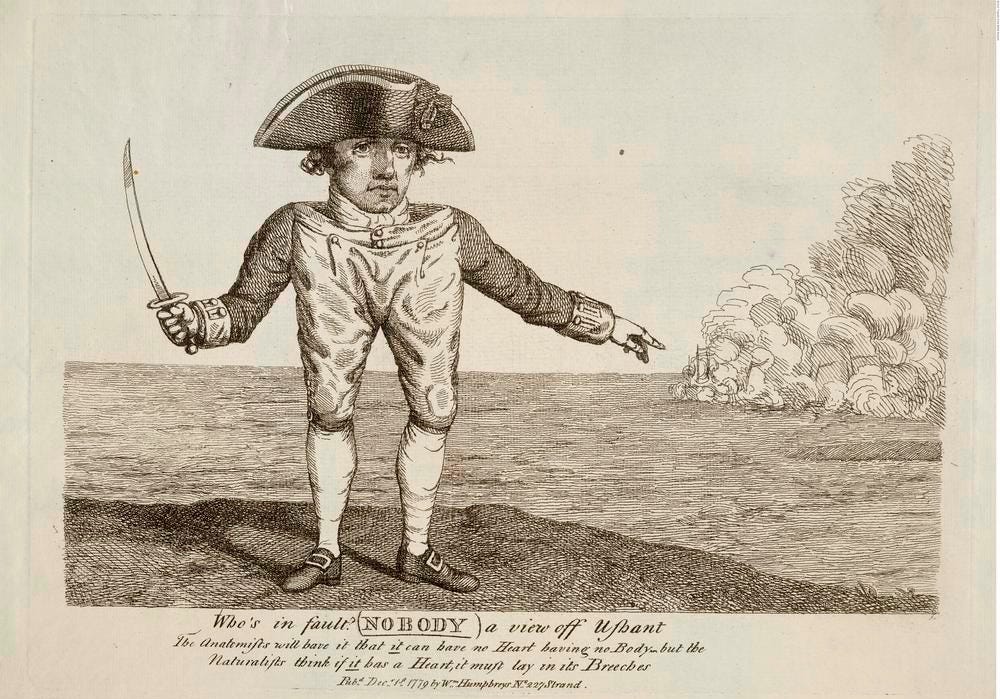
Image credit: William Humphrey, “Who’s In Fault?”, 1779. https://www.britishmuseum.org/collection/object/P_J-1-94
Weber, Eugen. Peasants into Frenchmen : The Modernization of Rural France, 1870-1914. Stanford, CA: Stanford University Press, 1976.
Burbank, Jane, and Frederick Cooper. Empires in World History : Power and the Politics of Difference. Princeton: Princeton University Press, 2010.
I think I agree with the outcome here, but not necessarily the framing. Whether China or the US are “coherent actors” somewhat misses the point. Any stylized model makes plenty of simplifying assumptions that are often individually incorrect. The question is how accurate the model is in the aggregate in predicting behavior. There are plenty of ways, for instance, in which people act economically irrationally, but stylized models nevertheless have significant explanatory power on the whole.
Here, the issue is that think Mearsheimer’s model breaks down as a framework for explaining behavior. Both in the sense that how Russia’s leaders and citizens conceive of themselves and their country matters, and in the sense that Mearsheimer falls into the common trap you pinpoint (also common among American leftists) of viewing the US as the only global actor with agency, and everyone else as an NPC whose behavior is determined by the actions of the US.
i have nothing quite so sophisticated as i see written here. but what i miss in mearsheimer is any sense of ethical behavior as a category that plays a role or should play a role (please excuse by clumsy writing and thinking). but i think a hegemon or any nation is judged by its ethics not just by its power. l was a small child (displaced person) in germany after ww2 and i still remember how dp's loved americans. one time supposedly eisenhower was supposed to be driving through. everybody was so thrilled. that is at least how i remember it from my understanding as a child. the specialness of americans. their goodness (at least supposed) their generosity (actual). what putin and his russia are known for is the gulags and murdering of journalists, not to mention the destruction of ukraine these days.